

Оборудование для фильтрации пива и вина
- Категория товара: Other Industrial Filtration Equipment >>>
- Поставщик (Оптовый магазин): Wenzhou,Qiangzhong,Machinery,Technology,Co.,Ltd.
Поделиться:
Описание и отзывы
Характеристики

Products Description

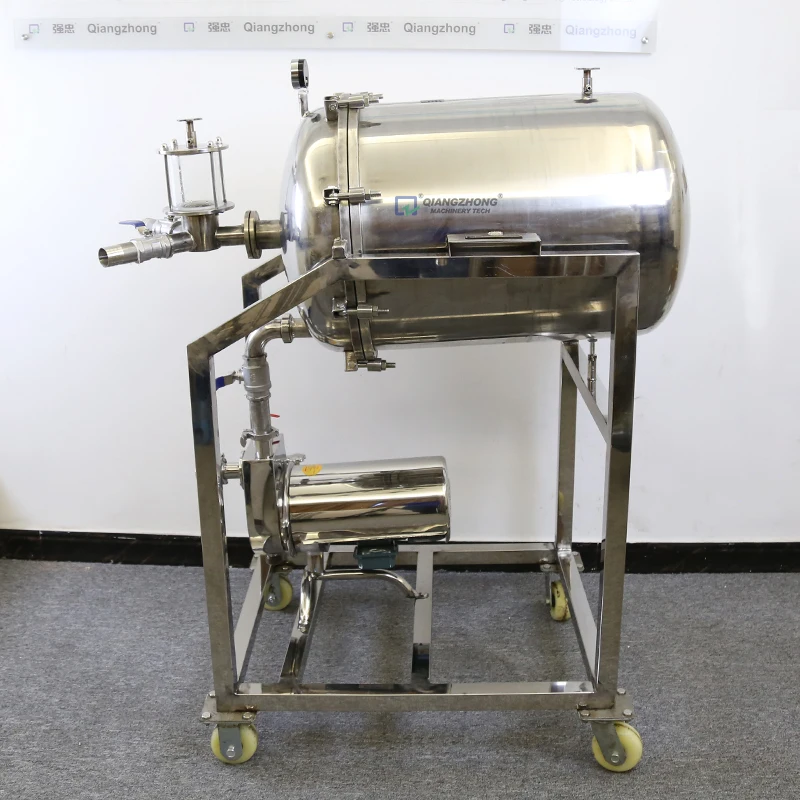
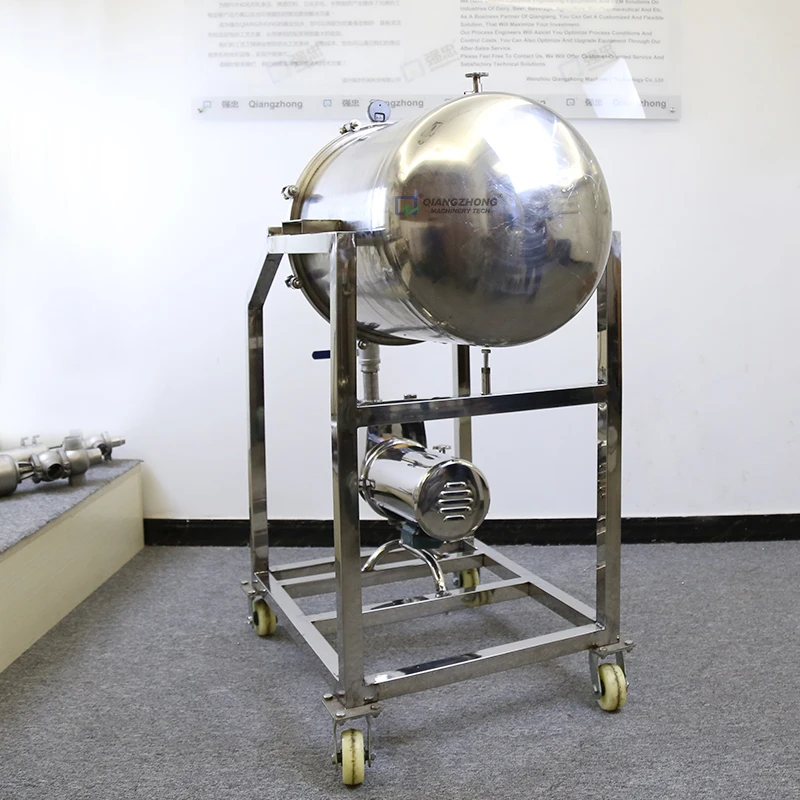
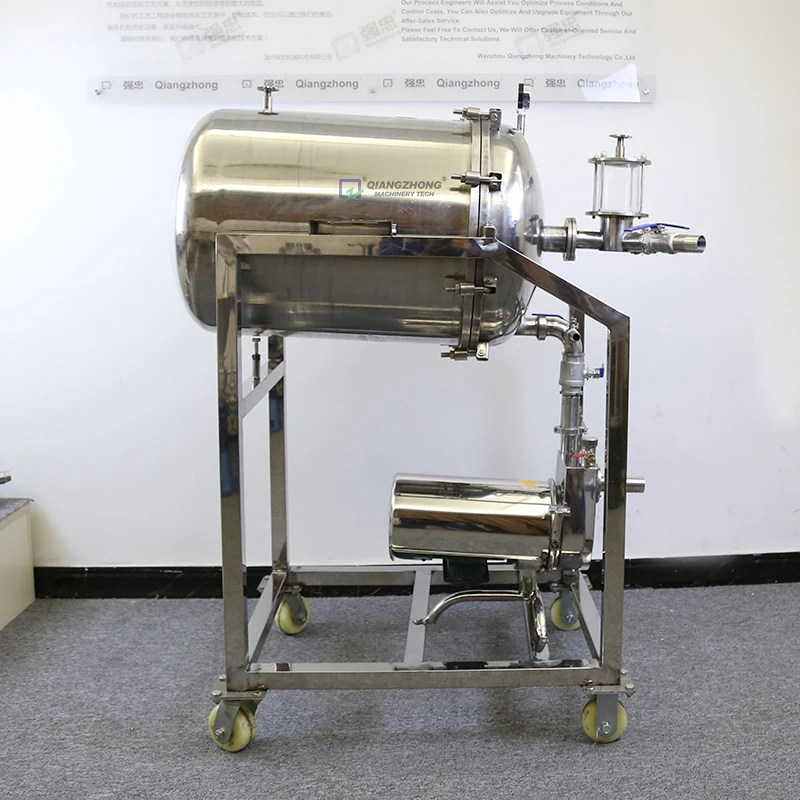
WK series Stainless Steel Diatomite Filter
This filter has been widely used in industries such as liquor, fruit wine, low-alcohol, rice wine, medicinal wine, grape wine and water treatment. Its filtration clarity is up to 99.8%, it can filter out particles (including microorganisms) below 1~0.1 microns, and even filter out E. coli.
Natural diatomaceous earth is not a good filter aid. It must be chemically treated, burned, crushed, washed, dried, ground and screened to remove organic and other impurities, improve graininess, porosity and surface properties in order to get good filtration performance.
Diatomaceous earth is a biochemical sedimentary rock formed by the cell wall of diatoms, an aquatic plant thousands of years ago. It has a myriad of small and complex pores, its particle size is very small, 2-100 micrometers in diameter, about 90% is a permeable void, its main component is silica, accounting for 85%-90%. It has good chemical stability, high temperature resistance, insolubility and non-toxicity. This porous particle provides an extremely powerful filtration function that removes particles (including microorganisms and bacteria) from 0.1 to 1 micron and even below 0.1 micron and retains the split.
It has the following features:
- Stable performance and good adaptability. Since the diatomaceous earth filter aid is mainly composed of silica, it is chemically stable and is suitable for use in cold and hot conditions and different concentrations of acid, without affecting the basic properties of the stock solution.
- High filtration efficiency and high clarity. The filter aids are of various sizes, the skeleton is hard, rich in single holes, multi-holes and many other shapes, so that the filter layer can not be tightly aggregated, has a large surface area and a large porosity, and achieves high filtration efficiency and the ideal clarity.
- Diatomaceous earth has a degerming effect. It has fine particles and forms a bio-protective film on the membrane to remove most pathogens.
Natural diatomaceous earth is not a good filter aid. It must be chemically treated, burned, crushed, washed, dried, ground and screened to remove organic and other impurities, improve graininess, porosity and surface properties in order to get good filtration performance.
Diatomaceous earth is a biochemical sedimentary rock formed by the cell wall of diatoms, an aquatic plant thousands of years ago. It has a myriad of small and complex pores, its particle size is very small, 2-100 micrometers in diameter, about 90% is a permeable void, its main component is silica, accounting for 85%-90%. It has good chemical stability, high temperature resistance, insolubility and non-toxicity. This porous particle provides an extremely powerful filtration function that removes particles (including microorganisms and bacteria) from 0.1 to 1 micron and even below 0.1 micron and retains the split.
It has the following features:
- Stable performance and good adaptability. Since the diatomaceous earth filter aid is mainly composed of silica, it is chemically stable and is suitable for use in cold and hot conditions and different concentrations of acid, without affecting the basic properties of the stock solution.
- High filtration efficiency and high clarity. The filter aids are of various sizes, the skeleton is hard, rich in single holes, multi-holes and many other shapes, so that the filter layer can not be tightly aggregated, has a large surface area and a large porosity, and achieves high filtration efficiency and the ideal clarity.
- Diatomaceous earth has a degerming effect. It has fine particles and forms a bio-protective film on the membrane to remove most pathogens.
Product Parameters


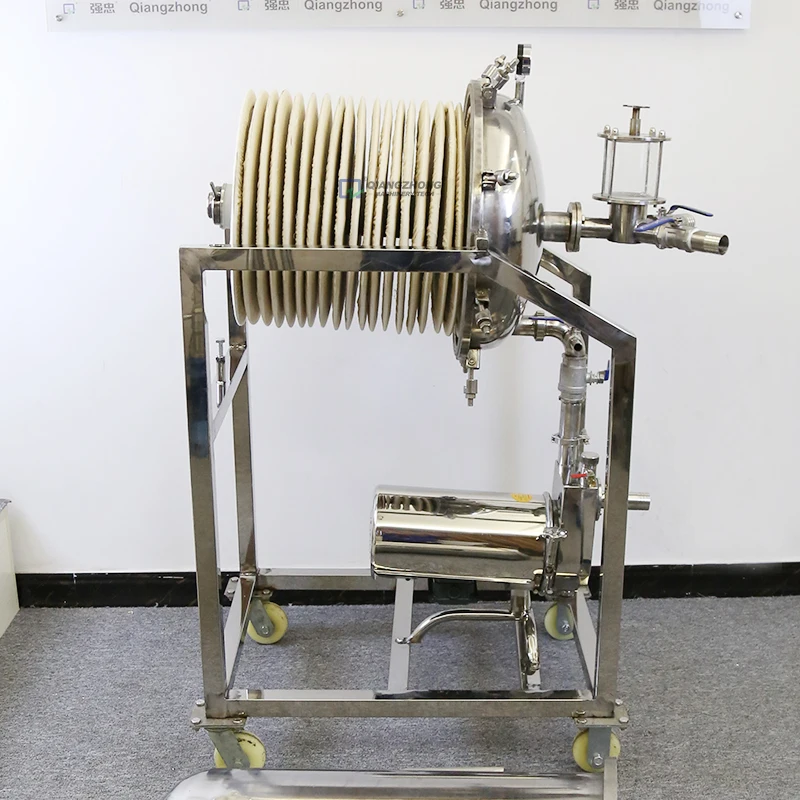
● This equipment consists of housing, intermediate shaft, filter plate, filter net, guide rod, air valve, glass mirror, caster, etc. All parts in contact with the liquid are made of stainless steel. The housing consists of multiple sections and single sections, sealed with rubber seals for easy removal and cleaning.
● Diatomaceous earth filter has obvious advantages over cotton cake filter:Energy savings of 92%; wine loss reduced by 90% Equipment cost savings of 2/3; production labor reduction of 3/4
● Diatomaceous earth filter has obvious advantages over cotton cake filter:Energy savings of 92%; wine loss reduced by 90% Equipment cost savings of 2/3; production labor reduction of 3/4


Working Principle

First, pour about 150 to 200 kg of unfiltered liquid into the container 10, then add diatomaceous earth and stir well. The proportion of diatomaceous earth is shown in the table: (pre-coating effect of the clear liquid is better).
● Connect the joints with rubber hoses (see installation diagram), then open regulator valve 9, inlet valve 7 and outlet valve 6, close outlet valve 5 and pneumatic beverage pump 8. At this time, the turbid solution in the pre-coating container 10 is pumped into the filter, and the diatomaceous earth inside is also introduced into the machine. As the filter cloth passes, it is circulated into the container 10 via the outlet valve 6. After repeated cycles, the diatomaceous earth in the turbid solution was uniformly attached to the filter cloth. Through the glass mirror, you can see the filtered solution, clear and bright. At this point, the exhaust valve 4 can be sampled and sent for inspection. Under normal circumstances, the turbid solution can be filtered after about 15 minutes of circulation to meet the requirements.
● After the sample has reached the requirements, close the outlet valve 6 and open the outlet valve 5 to bottle the clear liquid.
● This machine should be operated by a dedicated person. Do not close the outlet valves 5 and 6 during work. Otherwise, excessive pressure may damage the machine. Open the exhaust valves 1 and 4 before starting the machine. After the air is exhausted, close the exhaust valve. After the shutdown, the outlet valves 5, 6 and the inlet valve 7 are closed, the exhaust valves 1, 4 are opened, and the liquid in the filter is drained from the valve under the filter cartridge. Then open the shell, unscrew the shaft end nut, remove the filter element, wash the diatomaceous earth and adherent on the filter cloth with water, and assemble the machine in order for the next use.
● Filtration speed and filtration rate depend on the following factors:
The nature of the beverage, the level of alcohol, sugar, concentration, impurities, etc., the proportion and dosage of the filter aid, whether the formula is appropriate, whether the pressure meets therequirements.
● In the production process, in order to increase the continuous filtration time and speed up the filtration rate, diatomaceous earth may be added as necessary. When the turbidity is high, the liquid flows into the container 10, and the diatomaceous earth is added to the container in a dose. The dosage is 0.05-0.1 kg of diatomaceous earth per 100 liters of the liquid to be treated, and the dosage can be increased or decreased according to actual conditions.
● Precautions for filtration with diatomaceous earth filter aid:
In the precoating process, the key to the success of the filter is to form a uniform, stable, crack-free and desolvent diatomaceous earth precoat. The main influencing factor is the mesh size of the filter medium used, which matches the viscosity of the filtered slurry and the viscosity on the diatom. The poor rigidity of the filter media is also a major cause of cracking. When the filter medium is under a small pressure, it will not be deformed. The resistance gradually increases with time. When the support stiffness is insufficient, deformation occurs, causing cracks in the precoated diatomaceous earth layer. In addition, when diatomaceous earth is used alone and the particle size is too fine, cracking may occur. At this point, a certain amount of asbestos fibers can be mixed into the diatomaceous earth to prevent cracks from appearing.
During the precoating process, diatomaceous earth forms a soil layer having a thickness of 2 mm, uniform, stable, and free from cracks and shedding on the filter cloth. Such thickness values are commonly used and are based on experience. If the flow rate is too slow during precoating, the precoat layer will be dispersed, damp and unstable. If the flow rate is too fast, the precoat pressure will increase and the pressure of the transferred liquid will be higher. Thereby, the working pressure range is narrowed, the filtration time is shortened, and the production capacity is affected. Therefore, after the precoating process and after completion, the pressure needs to be adjusted to 0.5-1.5 kg/cm3 to facilitate the filtration.
If it is necessary to suspend during the production process, first close the outlet valves 5 and 6, then close the inlet valve 7, and finally close the pump 8, so that the pressure inside the chamber will increase. When the machine starts working again, it is necessary to start the pump 8, then open the inlet valve 7, and finally open the outlet valves 5 and 6. Why should we maintain the pressure inside the machine? The purpose is to prevent the diatomaceous earth layer attached to the filter cloth from falling off. On the other hand, if the liquid and pressure in the machine are not maintained, the next time the machine starts working, the pump will have a high flow rate
● Connect the joints with rubber hoses (see installation diagram), then open regulator valve 9, inlet valve 7 and outlet valve 6, close outlet valve 5 and pneumatic beverage pump 8. At this time, the turbid solution in the pre-coating container 10 is pumped into the filter, and the diatomaceous earth inside is also introduced into the machine. As the filter cloth passes, it is circulated into the container 10 via the outlet valve 6. After repeated cycles, the diatomaceous earth in the turbid solution was uniformly attached to the filter cloth. Through the glass mirror, you can see the filtered solution, clear and bright. At this point, the exhaust valve 4 can be sampled and sent for inspection. Under normal circumstances, the turbid solution can be filtered after about 15 minutes of circulation to meet the requirements.
● After the sample has reached the requirements, close the outlet valve 6 and open the outlet valve 5 to bottle the clear liquid.
● This machine should be operated by a dedicated person. Do not close the outlet valves 5 and 6 during work. Otherwise, excessive pressure may damage the machine. Open the exhaust valves 1 and 4 before starting the machine. After the air is exhausted, close the exhaust valve. After the shutdown, the outlet valves 5, 6 and the inlet valve 7 are closed, the exhaust valves 1, 4 are opened, and the liquid in the filter is drained from the valve under the filter cartridge. Then open the shell, unscrew the shaft end nut, remove the filter element, wash the diatomaceous earth and adherent on the filter cloth with water, and assemble the machine in order for the next use.
● Filtration speed and filtration rate depend on the following factors:
The nature of the beverage, the level of alcohol, sugar, concentration, impurities, etc., the proportion and dosage of the filter aid, whether the formula is appropriate, whether the pressure meets therequirements.
● In the production process, in order to increase the continuous filtration time and speed up the filtration rate, diatomaceous earth may be added as necessary. When the turbidity is high, the liquid flows into the container 10, and the diatomaceous earth is added to the container in a dose. The dosage is 0.05-0.1 kg of diatomaceous earth per 100 liters of the liquid to be treated, and the dosage can be increased or decreased according to actual conditions.
● Precautions for filtration with diatomaceous earth filter aid:
In the precoating process, the key to the success of the filter is to form a uniform, stable, crack-free and desolvent diatomaceous earth precoat. The main influencing factor is the mesh size of the filter medium used, which matches the viscosity of the filtered slurry and the viscosity on the diatom. The poor rigidity of the filter media is also a major cause of cracking. When the filter medium is under a small pressure, it will not be deformed. The resistance gradually increases with time. When the support stiffness is insufficient, deformation occurs, causing cracks in the precoated diatomaceous earth layer. In addition, when diatomaceous earth is used alone and the particle size is too fine, cracking may occur. At this point, a certain amount of asbestos fibers can be mixed into the diatomaceous earth to prevent cracks from appearing.
During the precoating process, diatomaceous earth forms a soil layer having a thickness of 2 mm, uniform, stable, and free from cracks and shedding on the filter cloth. Such thickness values are commonly used and are based on experience. If the flow rate is too slow during precoating, the precoat layer will be dispersed, damp and unstable. If the flow rate is too fast, the precoat pressure will increase and the pressure of the transferred liquid will be higher. Thereby, the working pressure range is narrowed, the filtration time is shortened, and the production capacity is affected. Therefore, after the precoating process and after completion, the pressure needs to be adjusted to 0.5-1.5 kg/cm3 to facilitate the filtration.
If it is necessary to suspend during the production process, first close the outlet valves 5 and 6, then close the inlet valve 7, and finally close the pump 8, so that the pressure inside the chamber will increase. When the machine starts working again, it is necessary to start the pump 8, then open the inlet valve 7, and finally open the outlet valves 5 and 6. Why should we maintain the pressure inside the machine? The purpose is to prevent the diatomaceous earth layer attached to the filter cloth from falling off. On the other hand, if the liquid and pressure in the machine are not maintained, the next time the machine starts working, the pump will have a high flow rate
Product details
Product Paramenters


Advantages
Certification | 25 National Patents, Audited by SGS/TUV/CE/ISO9001 |
Quality Guarantee | Complaint rate as low as 5‰ for 15 years. If you decide to purchase from us, any malfunction happened, once you enquiry us, we will reply you solution within 48 hours except the special reasons |
Short Lead Time | Lead time is flexible. Short turnaround of replacement parts made by substantial storage, Normally we are 20% faster than others. If you have urgent orders, pls feel free to contact us. We will get the job done with 100% satisfaction. |
24/7 Available | All your inquiry will be responded within 1 hour. All your quotation will be satisfied within 12 hours. |
Why choose us? | •100% manufacturer • Rich production experience •Strict Quality Control System •Flexible MOQ •Punctual delivery •Excellent and Experienced Team |
Company Profile
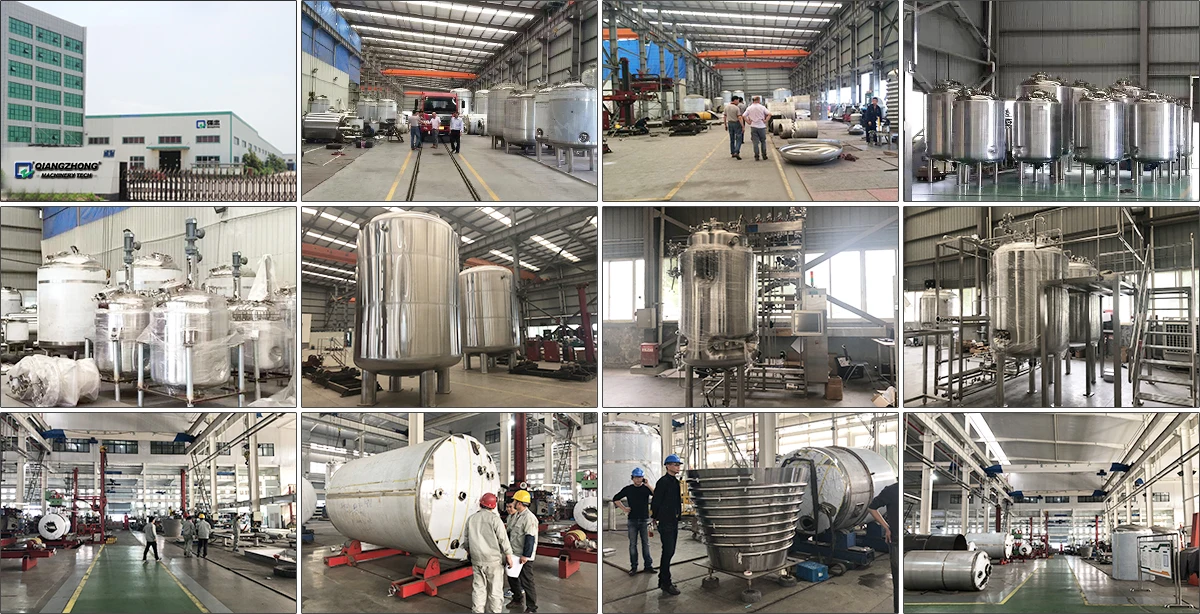
Wenzhou Qiangzhong Machinery Technology Co., Ltd. is a professional manufacturer of processing machines, located in Wenzhou City, China, near Longwan International Airport. Our main products include the high shear mixer, mixing tank, colloid mill, sanitary pump, sanitary filter, sanitary pipe, and valve. They are widely used in industries such as brewery, dairy product, beverage, chemicals, cosmetics, pharmaceuticals, and biopharmaceuticals.
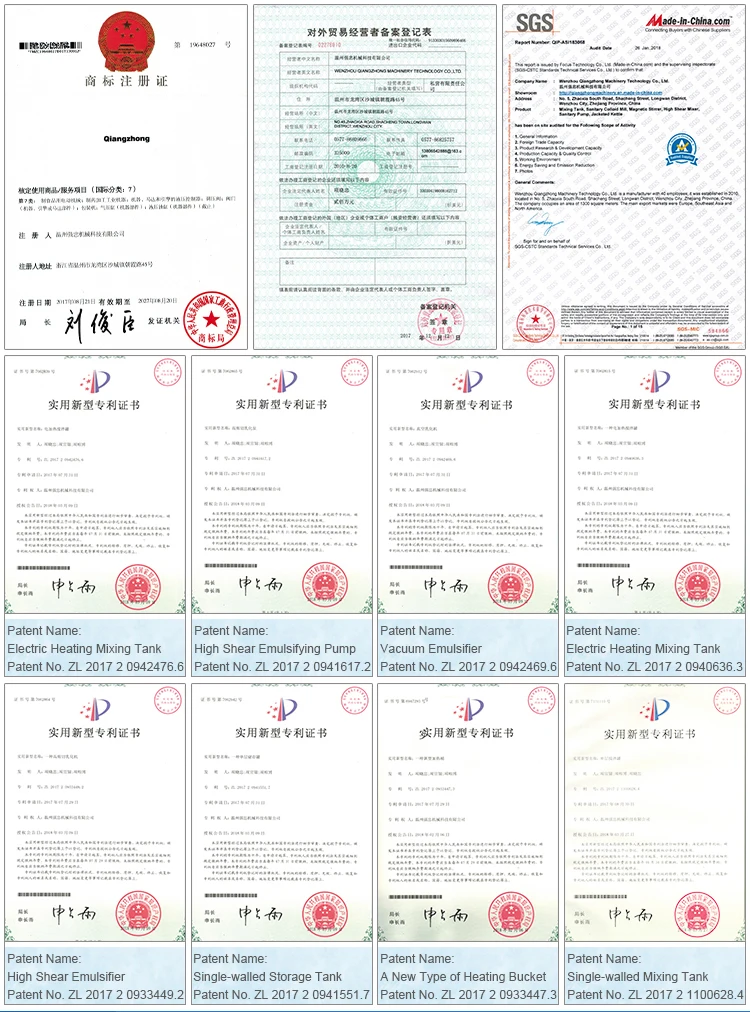
We offer complete sets of service from research and development, production, sales, after -sales to maintenance, in accord with GMP, QS, and HACCP. As a pioneer and innovator, Obtain 25 National Patents, Audited by SGS / TUV / CE / ISO9001.

Thanks to advanced technologies and production equipment, strict meeting industry standards, our quality is well-developed continuously. So far, our products have been sold not only all around China but also globally, such as Europe, America, Australia, Southeast Asia, Middle East, etc.

Packaging & Shipping
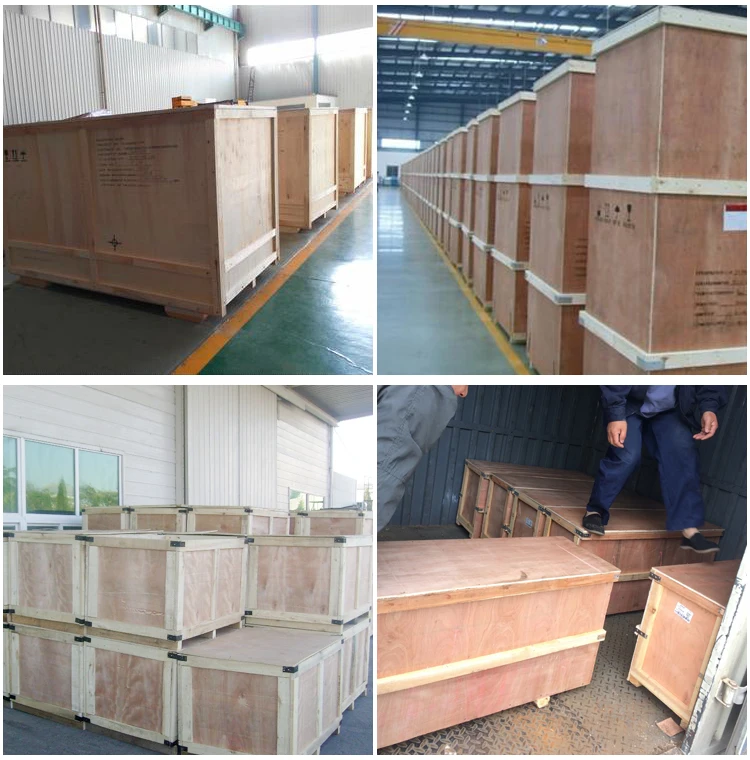
Strict packing process to ensure the safety and completeness of the goods
We are experienced in the whole packing and shipping process, and we will be responsible for any damage made during shipping and send clients replacements for free.
* Sufficient inner protection with different materials, including bubble bag, foam board and others.
* Qualified wooden package or carton for different products or as customer require.
* Sufficient inner protection with different materials, including bubble bag, foam board and others.
* Qualified wooden package or carton for different products or as customer require.


